- A new study reveals that the true legacy of the Green Revolution lies not just with one big breakthrough, but in thousands of small advancements over decades
- Since the introduction of “Miracle Rice” in 1966, IRRI’s breeding programs have delivered consistent 0.58% annual yield gains, underpinning global food security today
- Amid declining funding, advanced innovations from public breeding programs will be key to meeting future food security needs
By Glenn Concepcion
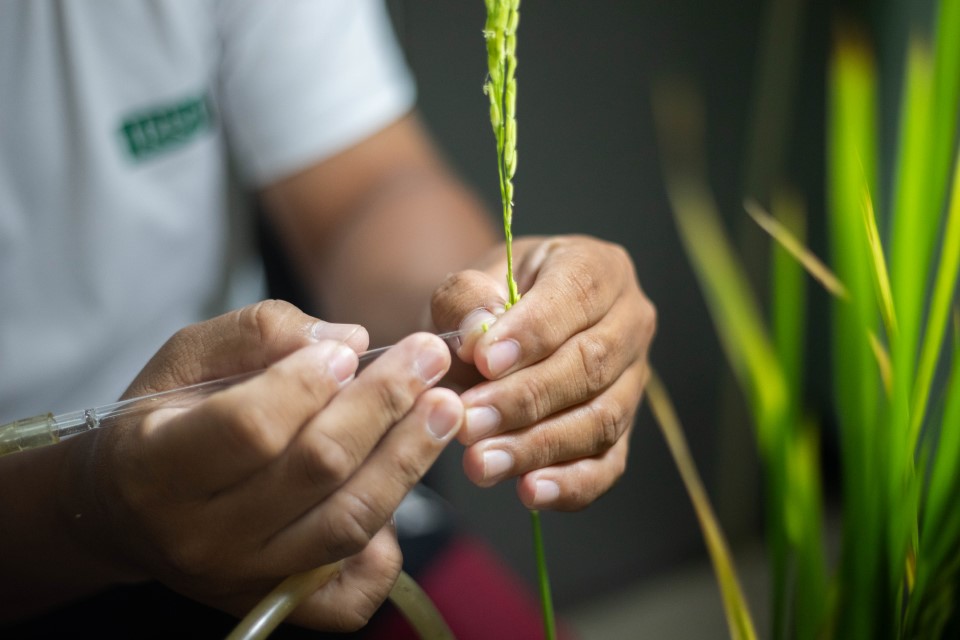
In 1966, the release of a newly bred rice variety known as IR8 changed the course of history. Dubbed “Miracle Rice” because of its almost unbelievable yield increase (as much as 3-5x compared to other varieties), it launched the Green Revolution in Asia, averting famine and alleviating poverty across the region.
Sixty years later, a new study published in the journal Food Security argues that the true legacy of the Green Revolution isn’t found in that single “miracle” moment, but in the subsequent decades-long pursuit for incremental genetic gains that continues to feed millions of people even today.
Quantifying genetic improvement over time
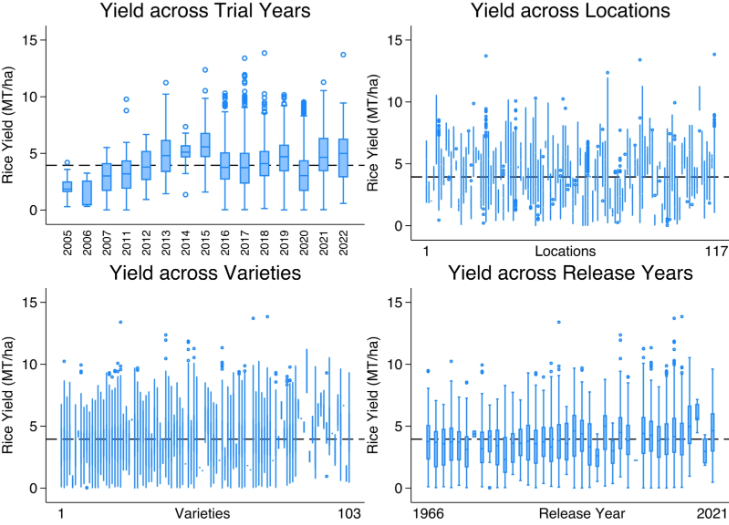
The paper, written by an international team of economists and scientists from the University of Arkansas, Kansas State University, and the International Rice Research Institute (IRRI), provides the first large-scale assessment of how genetic improvements in rice developed by IRRI translated into real-world market impacts and food security outcomes. By analyzing over 12,000 yield observations spanning 15 years and 19 countries, the team has quantified a slow but steady progression in genetic gain.
The core finding of the study is both encouraging and a call to action: since the release of IR8, IRRI’s elite rice lines have achieved an average annual genetic gain of 0.58%. While this figure might appear modest compared to the 1.5% annual gain many experts believe is necessary to meet 2050 global demand, the researchers emphasize its significance.
“It is impressive that since the release of IR8, yield gains have not plateaued,” the authors note, highlighting that these gains have been sustained for over 55 years. This consistent improvement suggests that breeders are successfully navigating a biological arms race against evolving pests, diseases, and the escalating impacts of climate change.
To arrive at this number, the team employed a rigorous econometric model that controlled for location and time fixed effects such as environmental factors like soil quality and weather shocks that can obscure the true impact of a variety. By treating the release year of each variety as its “technological vintage,” they were able to isolate the specific contribution of breeding to yield increases.
The impact in Indonesia and the Philippines
The study moved beyond the laboratory and trial plots to examine the downstream effects in Indonesia and the Philippines, two of the world’s largest rice consumers. The results were staggering: In these two nations alone, the adoption of IRRI-developed varieties has increased the annual rice supply enough to feed an additional 25.14 million people.
In the Philippines, where rice accounts for 42% of total caloric intake, IRRI varieties provided an average of 7.89 million additional annual rations between 1991 and 2021. In Indonesia, the impact was even larger, providing an additional 17.25 million rations.
The analysis utilized the “RiceFlow” model—a complex simulation of the global rice economy—to ask a counterfactual question: what would the world look like if IRRI’s breeding program had simply stopped after the 1966 “miracle”? The model showed that without these incremental genetic gains, rice would be significantly less affordable. In both countries, the presence of continuously improved IRRI varieties lowered consumer rice prices by approximately 10%, a vital benefit for low-income households who spend a large portion of their income on staples.
Preventing “invisible” losses
A critical, yet often undervalued, aspect of the research is the role of “maintenance breeding”. Roughly 40% of agricultural research is dedicated simply to keeping yields where they are, protecting previous gains from new strains of blast pathogens or shifting climate conditions.
“The substantial economic benefit that accrues from avoided yield losses through maintenance breeding is typically not valued,” the researchers explain. Because farmers don’t experience the losses that were prevented, the costs incurred by public institutions like IRRI to stay ahead of potential disasters can be less visible to donors, yet they remain no less important in safeguarding resilient food systems.
Navigating a future paradigm shift
The study arrives at a precarious time for public agricultural research, with funding increasingly constrained and breeding for other major crops like maize and soybeans becoming more concentrated outside the public domain. This is unfortunate, as public breeding programs remain the backbone for low-income regions where private investment is unlikely to yield high financial returns but is essential for social welfare.
Moreover, flagship cultivars like IRRI’s IR36 and IR64, which once covered tens of millions of hectares in the 1980s but have since been replaced by newer varieties, now serve as the essential germplasm pool for both national programs and private researchers. These “outdated” varieties remain relevant as they provide the diverse genetic material necessary for new crosses. Without the decades of public research embodied in these rice lines, the private sector would lack the foundation required to innovate quickly in response to market demands.
Finally, as the future of rice breeding moves toward a data-rich, evidence-based strategy utilizing artificial intelligence and machine learning, it will require massive amounts of historical data to function. The study highlights that the 15 years of rigorous trial data that evaluated how different “vintages” perform across diverse environments is exactly what will power the next generation of rice breeding. By quantifying the performance of older lines, scientists can better calibrate expected goals and provide a benchmark for future successes.
Working together for small miracles
The research argues that the 1.5% yield gain target for 2050 should not be a burden for breeders to carry alone. Instead, it requires a multi-pronged approach involving various stakeholders to close the gap, including agronomists to enhance crop management, engineers to improve irrigation, economists to ensure affordable inputs, and extension services to deliver innovations to farmers.
The story of rice since 1966 is not of a single big miracle, but of thousands of small incremental miracles in the labs and the fields. The genetic footprint of the Green Revolution continues to battle global food insecurity today, but only if the public support that fuels this slow but steady process is maintained.
“There are no miracles in agricultural production,” the study reminds us, echoing the words of Nobel Laureate and Father of the Green Revolution Norman Borlaug. There is only the continuous, gradual, and vital progression of science.
Read the study:
Lawton Lanier Nalley, Jesse Tack, Alvaro Durand-Morat, Valerien Pede, Donald Villanueva
Linking genetic gains to food security outcomes: An assessment of IRRI’S rice breeding efforts in the Philippines and Indonesia
Food Security: The Science, Sociology and Economics of Food Production and Access to Food (2026)
https://doi.org/10.1007/s12571-025-01632-7