Rice straw management provide clear economic and environmental benefits. But to make it work at scale, a systemic shift is needed to overcome technical and logistical hurdles like limited machinery access, challenges in field trafficability, while establishing reliable market demand and value chains.
By Christian Dohrmann, Bui Yen, Danica Louise Sembrano, Trang Vu
Rice farming feeds millions of people, but it also leaves behind a massive amount of straw.
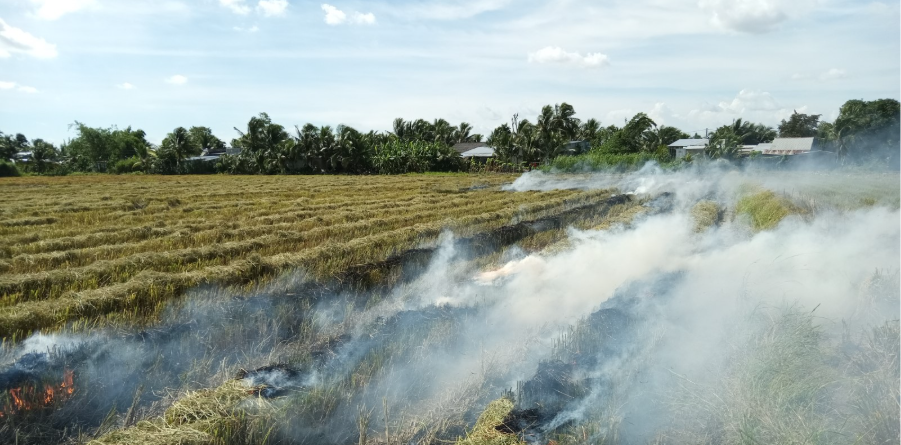
According to the Food and Agriculture Organization1, rice straw approximates from 530 million to 1 billion tons annually. With only a short window before the next planting season, farmers must clear their fields quickly. The options are familiar: burn it, incorporate it into the soil, or collect it for reuse. Too often, open-field burning becomes the default because it is fast and accessible. But what saves time also costs consequences that extend far beyond the field.
Burning produces a combination of hazardous pollutants, including greenhouse gases (GHG) and fine particulate matter. These substances degrade air quality, contribute to an already strained climate system, and pose serious health risks, such as respiratory and cardiovascular diseases.
While straw burning is often discussed as a behavioral issue, in many cases, it is a systems problem. When fields are too wet for heavy machines, roads are inaccessible, or there is no market for straw, burning becomes the only viable default. Solving this requires a combination of regulations, incentives, and market development for straw uses, and IRRI contributes to this agenda by generating evidence, testing options with partners, and translating field constraints into realistic guidance for programs and investment.
What does a better path look like?
An alternative to burning is to incorporate straw back into the soil. But while this practice can improve soil organic matter over time, it is not a simple “green” solution.
In flooded fields, incorporated straw decomposes under low-oxygen (anaerobic) conditions, leading to increased methane emissions. As estimated by IRRI following IPCC guidelines2, incorporating a ton of straw into the soil for less than 30 days before cultivation increases methane emissions per ha in the season by over 50% compared with no residue incorporation. It also creates excessive phytotoxic compounds, which inhibit the establishment of new seedlings and root systems. That’s why a short pre-season drying period is commonly recommended in many rice-growing countries. However, a time window to dry fields between two rice cultivation cycles may not always be feasible for farmers.
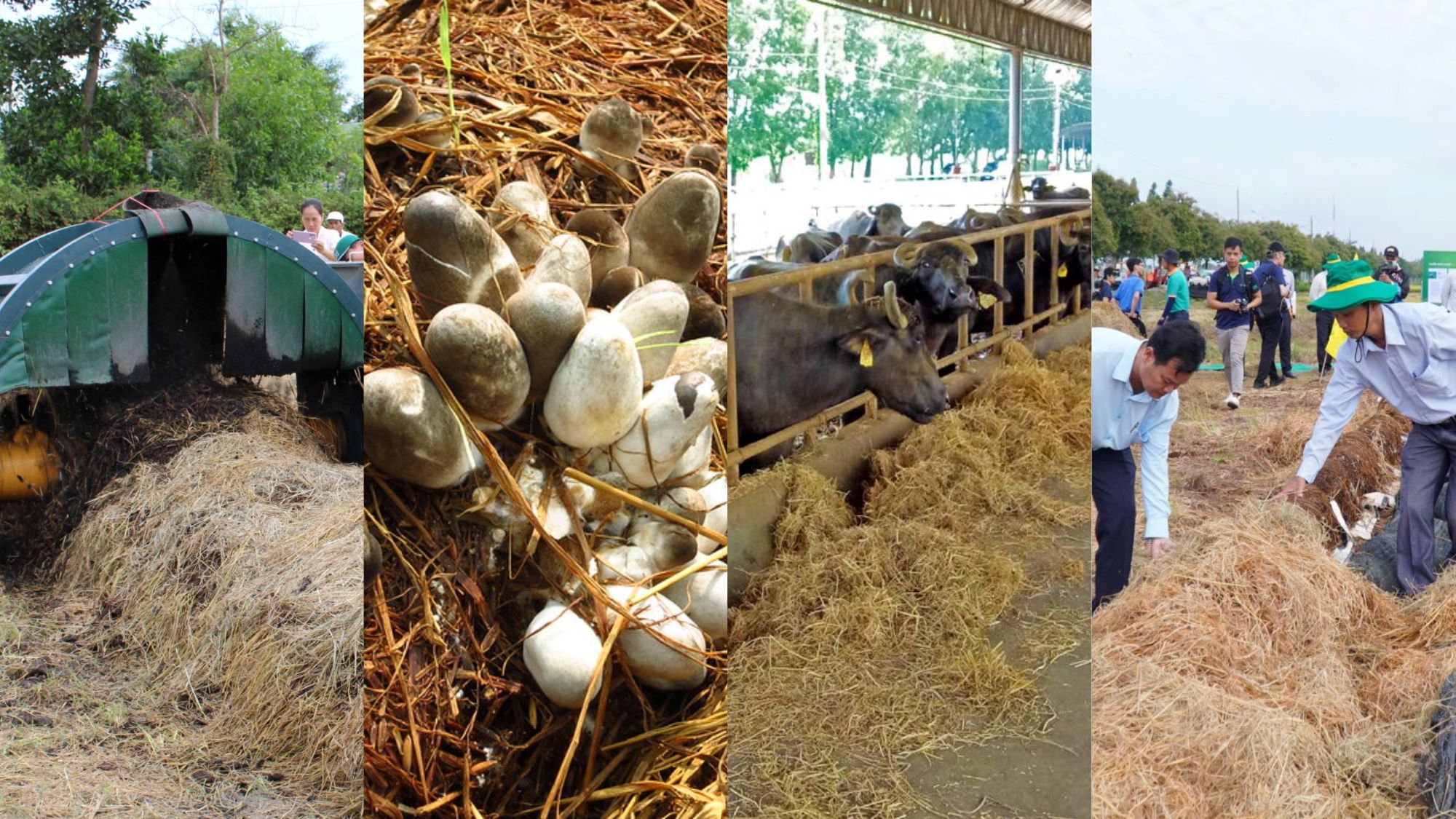
A promising direction is to reframe rice straw as a resource instead of a waste product. By collecting and repurposing straw for mushroom cultivation, livestock feed, compost, mulching, or biochar, farmers can reduce emissions while unlocking new revenue streams
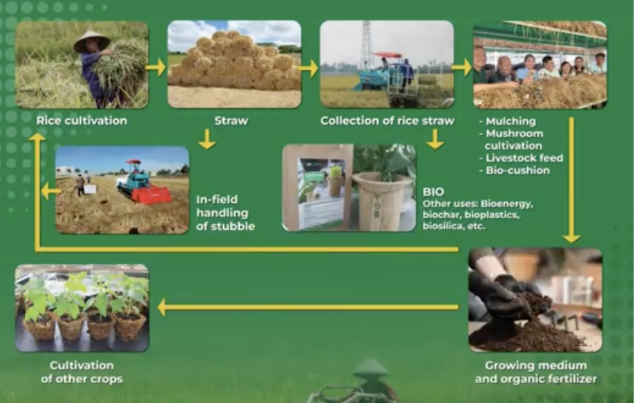
However, scaling these solutions is not straightforward. After harvesting, straws are scattered across fields and bulky when collected. Collecting and transporting it requires more labor or machinery costs, as well as time pressure to prepare the field quickly for the next crop. This circumstance makes collection a logistical, economic, and technical challenge.
How much straw is there to deal with after harvest?
The volume, timing, and wetness of straw to be tackled influence planning its collection, transportation, storage, and end use.
A single harvest produces nearly as much straw residue as the grain, given the average ratio of grain/above ground biomass at harvest (harvest index) is 0.5. About 47 million tons of rice residue is produced in Vietnam3, 15 million tons in Cambodia4 and 15 million tons in The Philippines5 annually.
Variety characteristics, such as plant height and harvest index, and cutting height influence how much straw is left behind, while moisture at harvest also affect farmers’ decision on dealing with the straw. Wet straw is less preferred for collection because it is harder to compress, raises handling and transport costs, and affects storage and processing efficiency.
In other words, more straw volume and wetter straw means more trips for machinery, more collection time, and higher costs.
Is mechanized collection the obvious choice?
A recent study shows that farmers in Southeast Asia weigh a range of economic, technical, and operational factors when deciding whether rice straw should be collected after harvest.
Cambodian farmers identified market demand and straw profitability as the strongest drivers of straw collection, highlighting the importance of reliable buyers and attractive prices. Household demand for straw also remains significant, showing its continued role as a farm resource.
For Vietnamese farmers, profitability and market demand were likewise deemed important, but access to machinery were considered the most critical determinant to rice straw collection. The availability of balers and other equipment is viewed as essential for reducing labor requirements and enabling efficient straw recovery. Institutional support from government agencies, cooperatives, and farmer organizations, as well as larger and more concentrated production areas, further improve the feasibility of collection.
However, machinery and profitability alone do not guarantee that straw can be collected.
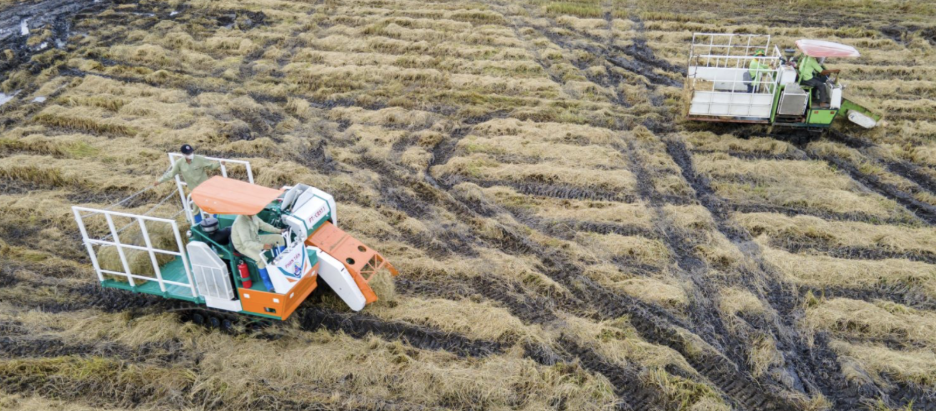
Beyond these preferences and considerations, rice straw collection is also determined by infrastructure-, operational, and environment-related factors, especially by service providers:
- Timing. Straw collection usually happen in a short window before land preparation starts for the next crop. The shorter the window, the more challenging it is to arrange for straw collection. In cases when there are only a few days between two seasons, farmers often opt for burning to be able to prepare the land shortly.
- Accessibility and logistics. The distance between rice fields to accessible roads to efficiency in transportation. Moreover, narrow, unpaved, or rutted rural roads can make maneuvering heavy equipment and transporting bulky straw nearly impossible.
- Field trafficability and the “mud” factor. Because rice is grown in humid climates, fields are often still wet at harvest, except during the dry seasons in parts of some countries like Cambodia, Thailand, and Vietnam. Field trafficability, affected by soil moisture, terrain, and flood risk, was identified as the most critical factor influencing machinery operations.
- Farm layout. Small, scattered plots increase time it requires to go from field to field and thereby operation cost, especially when machinery is borrowed from third party providers. Clustered or cooperative block harvesting can improve the collection efficiency with less distance being traveled.
A regional shift toward scalability
Handling rice straw has become a regional issue, not only a local farm practice. Across rice-producing countries, no-burning of rice residues is increasingly becoming a part of low-emission policies, climate pledges, sustainability initiatives, and wider land and fire management. Across Southeast Asia, countries are now increasingly framing straw management through the lens of haze control and sustainable land management, with policy approaches that combine practical support, collective logistics, value-chain development, and disincentives for burning.
This shift matters because it changes the question from “what should farmers do about it” to “what systems make straw management workable at scale.” Mechanized collection and straw value chains can help, but they depend on real constraints like road access, plot fragmentation, field conditions, and short post-harvest windows. Understanding these drivers and constraints helps governments and investors target support where it can actually work and avoid well-funded interventions that fail in the field.
What will it take to scale alternatives to burning?
The shift away from burning will not scale through machinery or infrastructure alone. Farmers need a working market around rice straw: reliable buyers, fair value, collection services, transport, storage, and end uses that make the effort worthwhile. When straw has a clear destination and value, it becomes a resource rather than a burden.
In Vietnam’s Mekong River Delta, mechanized straw collection services have expanded over the last decade, partly driven by labor shortages and tight harvest windows. Reported numbers suggest thousands of straw balers are now operating in the region, and collected straw is already feeding local uses such as animal feed and mushroom cultivation.
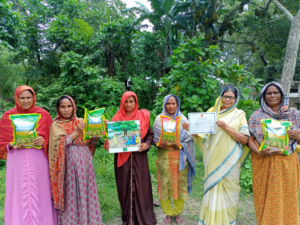
This is also evident in RiceEco pilot farms in Vietnam and Cambodia, which showed how the right combination of innovation, farmer support, and investment can transform rice straw into both an environmental and economic opportunity. Farmers adopting circular straw management practices saw incomes rise by up to 12% or around USD 200 per hectare. The project also demonstrated that removing rice straw from fields, when paired with tailored incorporation practices, can cut greenhouse gas emissions by up to 36% without sacrificing yields.
Taken together, these experiences point to a larger lesson: scaling alternatives to burning will depend not only on technology, but on creating the conditions that allow farmers, service providers, and markets to move together.
References:
International Rice Research Institute. (2026). Survey on rice straw management in four provinces in Cambodia [Unpublished survey data].
1Food and Agriculture Organization of the United Nations. (2023). FAOSTAT statistical database. FAO. https://www.fao.org/faostat/
2Department of Crop Production. (2023). Technical manual: Rice straw management towards circular economy and low emission in the Mekong Delta. Ministry of Agriculture and Rural Development. https://hdl.handle.net/10568/132735
3Food and Agriculture Organization of the United Nations. (n.d.). GIEWS country brief: Cambodia. Global Information and Early Warning System (GIEWS). Retrieved June 5, 2026, from https://www.fao.org/giews/countrybrief/country.jsp?code=KHM
4Sumagang, M. M., et al. (2024). A P-graph approach for planning sustainable rice straw management networks. The Philippine Agricultural Scientist, 107(3), Article 6. https://www.ukdr.uplb.edu.ph/pas/vol107/iss3/6
5Intergovernmental Panel on Climate Change. (2019). 2019 refinement to the 2006 IPCC guidelines for national greenhouse gas inventories (Vol. 4, Ch. 5). IPCC. https://www.ipcc-nggip.iges.or.jp/public/2019rf/
6Cuong, O. Q., Demont, M., Pabuayon, I. M., & Depositario, D. P. T. (2025). What drives rice farmers away from straw burning? Evidence from the Mekong Delta, Vietnam. Environmental Challenges, 19.